Archive for the ‘Piano Technology’ Category

Stieff Plate Removal and Veneer repairs

Sunday, August 5th, 2007
Disassembly Complete
Yesterday, disassembly came to an end, as I was down to the soundboard! Ryan helped me remove the plate. We used the shop crane to good advantage. I’m glad we had it! Lesson learned: bind points are at the front of the piano, not at the back. Thus, it is important to lift primarily at the front. It wasn’t a problem as we went slowly and monitored progress well.

Piano vintage confirmed:

While the eBay listing for this piano suggested it was made in 1905, the serial number is only three different from my own piano, which had been dated to 1911 by the prior owner. Upon the removal of the plate we found the 100 year old chalk marks on the back which clearly identify this piano as 1911. End of story.

Veneer Repair Begins
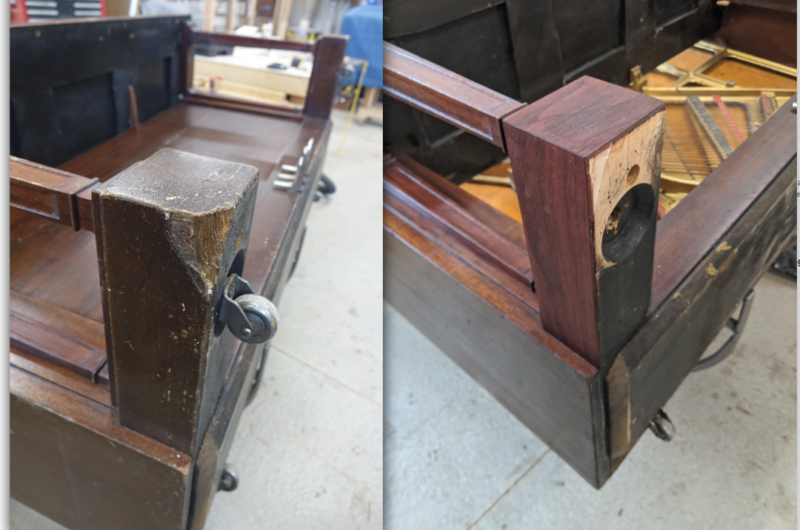
My hypothesis is that the piano was stored on its side in a damp location at one time. There is evidence of mold on the soundboard and bridges of the piano. The veneer suffered buckling and separation on the left side. Repair to the buckled veneer is to be as follows:

  1. Rout 1/8″ channel through the buckled veneer at its peak to relieve the buckle.
  2. Re-glue the veneer
  3. Fill the routed channel

The inside veneer was separated at the top. It was re-glued using Titebond glue applied with a veterinary syringe.

More Photos on Flickr.com

Stieff Evaluation and Disassembly

Friday, July 6th, 2007

This week, I took a closer look at the piano, while disassembling it. Generally, I found that nothing was worse than I knew it could be, but a few things were not as good as I had hoped:

  • In preparation for measuring downbearing, I attempted to bring the piano up to pitch. I found at least a dozen unisons which would not hold pitch.
  • Almost uniformly, I measured zero downbearing from bottom to top.
  • The source of the veneer damage is certain to be water damage. I think that at one time the piano was stored on its side in damp or wet(!) conditions. There are mold markings on the left side of the sound board and on the bass bridge.
  • The hammers do not look as good as I thought they might be prior to removing the action. I guess that’s to be expected, as you can see them better once the action is removed! In any event, they appear to have been reshaped at some point. The topmost hammer is odd. Hammers in the top octave have worn through to the wood core. It is not clear whether the hammers are original or not.

BUT … I wanted to rebuild a piano, and this is a great one to rebuild.

There are also some really good things about the piano that I appreciate now that I have begun to dismantle.

  • The keybed is flat and looks great!
  • I found a missing ivory keytop inside the case. That should make a complete set. I’m pleased to have an ivory keyboard
  • I should have known (could have looked at my Stieff in the living room), but I am pleased to see agraffes from the bass through the first two thirds of the treble. Theory states that’s good for tuning stability, and that makes sense.
  • The action is really in great condition. It has kept good regulation and aside from hammers shows no serious wear or damage.


More pictures on Flickr.com

Shop Legs for the Stieff

Thursday, June 21st, 2007

To begin work on the piano, I built shop legs. These temporary replacement legs will allow me to move the piano around in the shop easily, without placing stress on the legs. 8 inch casters are much different than 2 inch brass wheels!


More pictures are here. (Flickr.com)

Grand Piano for Syracuse Arts Academy

Wednesday, June 13th, 2007

After buying the Stieff grand for myself in October of 2005, I’ve wanted to get back into piano rebuilding … particularly grand rebuilding. I thought it would be good to pick up an inexpensive grand as a first experience with grand rebuilding. I’ve also thought that the foyer of Syracuse Arts Academy (Terri’s new school) should have a grand piano. A grand piano is just a suitable icon for an “arts academy”, and of course it would add to the music program in a “grand way”.

These two objectives came to an obvious conjuncture, when I saw an affordable Stieff piano on eBay. I bought the piano and went to southern California to pick it up on June 9. I hope to have it rebuilt and in the school by October.

The completed eBay auction is here: (Ebay Auction)

I’ll be documenting progress on the project here. Terri took nice pictures of the California move. The pictures are here (Flickr.com).