Archive for the ‘Historic Technology’ Category

Pullman Coach 645 – Seattle 1976

Tuesday, December 6th, 2011

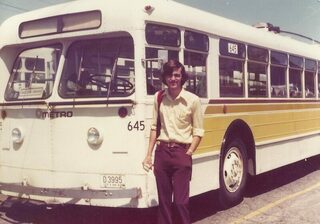
While remembering the days with Metro Transit in Seattle, I went looking for a photo of me! The photo below shows me getting ready for a summer morning run with Pullman Coach 645. The coach was most likely manufactured in 1940.


Trackless trolley #645 was a Pullman. The fleet had fewer Pullmans than Twins in the 70′s. There were perhaps 10 or 12 of them. They were a heavier, longer coach … a full 40′ I believe. An interesting aspect of the driver’s console was that the steering wheel was 11 inches closer to the center of the bus. That took some getting used to! The regenerative braking on the Pullmans was not as effective as that on the Twins. As a result, the Pullmans were not scheduled for the Queen Anne route with it’s extreme 17% grade. The paint job on this Pullman was very new at the time. It is sporting Metro colors, which match the driver uniform of the era.


Thank you Terri, for finding this photo! There are some obvious aspects of the driver’s appearance which require no comment by me! But I caught a couple of details here:

  • In my right hand is a stack of transfers. Clearly I was getting ready for a run.
  • On my left wrist is a wrist watch! An important piece of driver equipment, but novel, since I haven’t worn a wrist watch since I started carrying a pager in 1994 (and of course, subsequently a cell phone).


  • –Duane

    Trackless Trolley Coach 643

    Sunday, December 4th, 2011

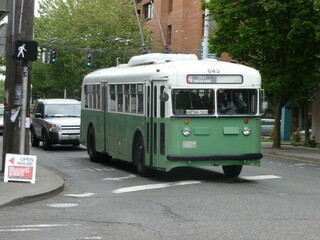
    I somehow got nostalgic this week for my days as a Metro Transit bus driver in Seattle.   Those days were a good experience, but it is also true that I enjoyed it more the first year than the following three.  There’s a good amount of tedium in the job!  But the one thing I appreciate most of all was the opportunity to operate the vintage trackless trolleys built in the 40′s.  This equipment was finally retired in 1979.  Metro then rebuilt and expanded the overhead and opened service with new equipment a year later.  A few coaches have been restored by an association of retired employees.  Hoo-rah!   While in my nostalgic mood, I found the following photo of Coach 643.  It was taken in 2009, while the coach was out for an annual trolley tour!


    Old Seattle City Buses

    Timber Frame Workshop

    Sunday, November 7th, 2004

    In September, I posted here observations about a barn in Menlo, and the thoughts it spurred in me. Mostly it reminded me that my woodworking and construction projects of a lifetime have been on a small scale and it got me to thinking that I need to jump out and do some larger projects. As the thought progressed, somehow I moved into thinking about timber frame construction as a mode for the the project. Timber frame construction is traditional post and beam construction in which all joints are crafted of wood and joined with hardwood pegs. As the thought progressed, I realized that the project would follow this path:

    1. Buy a portable saw mill
    2. Buy some logs
    3. Make some lumber
    4. Build the frame
    5. Erect the building

    Wind River Shop

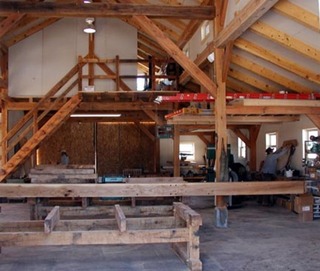
    The Wind River Timberframes Shop

    Quite non-traditional and very exciting.

    Yesterday I attended the Log and Timber Framing Expo in Sandy, UT. I came away with some valuable contacts and information. Represented at the show were two small firms from the region:

    Chuck Brainerd and Dale Covington (Barn Owl) and Alan Bernholtz (Wind River) generously shared their thoughts and enthusiasms for the art of the timberframe. Chuck has built an impressive home for himself in Utah from a barn he salvaged in the midwest. Alan has completed many masterful homes, and his new workshop is a beauty in itself. I can’t expect to build anything of that scale, but it is an inspiration.

    There’s a story here

    Thursday, February 26th, 2004
    Click to see a full size image

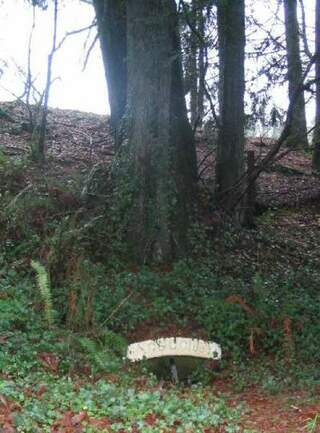
    The roadside is full of delights. But when you are four years old the delights are larger than life. The roadside of my four-year-old life was US 12 between Raymond and Centralia, Washington. It was the road travelled to Grandma’s house for weekend visits and Sunday chicken dinners. That’s chickens that had not long been without feathers! But back to the road …

    At Frances Washington, in 1914, the AC&C club built this improvement to a spring. Who was the AC&C? In the ghost of a town, who maintains this roadside delight today? I can remember stopping here frequently in the 50′s and I don’t remember any counsel of “don’t drink the water”. I could tell you that the water was sweet. But in fact I don’t remember the drinks I took here. But when I write the story, I will of course report that the water was sweet. Do I not remember the water because it was commonplace to have a drink in a spring alongside the road? Or do I not remember the water because in fact I had a Coke in the car? Certainly not the latter! Soda pop was experienced on the 4th of July. Not on a trip to Centralia.

    Each year, Terri uses the story, Tuck Everlasting, in her fifth grade class. It is a delightful mythical tale of a family who does not age. Ultimately it is learned that their aging has ceased, because they once made the decision to drink the water from a very special spring. I told Terri that my image of this Frances spring is the image I draw from the story of Tuck Everlasting. It is good sweet water, and a good sweet story.

    Also at Frances is a once proud building, with a purpose which I cannot descern. So here is another set of questions and an untold story. Each year as I drive by the west side of the building sinks a bit further into the rain-soaked hillside. And the east side of the building retains much of its dignity upon its concrete foundation. Frances was both a mill town and an agricultural town. I’m aware of creameries and cheese factories down the road in Menlo, but their architecture is much different from this building. I note with interest the two rows of small windows on the west side of the building. Between the two rows, is a row of vents. What was this building?

    Click to see a full size image

    Click on the top and bottom photos for full size images.